
26-PhE Philosophy of education
Tutors: Johannes Drerup, Julien Kloeg, Michael Merry, Anders Schinkel (coordinator)
ECTS (for the full course; 1 ECTS=28 hours): 3
Course description
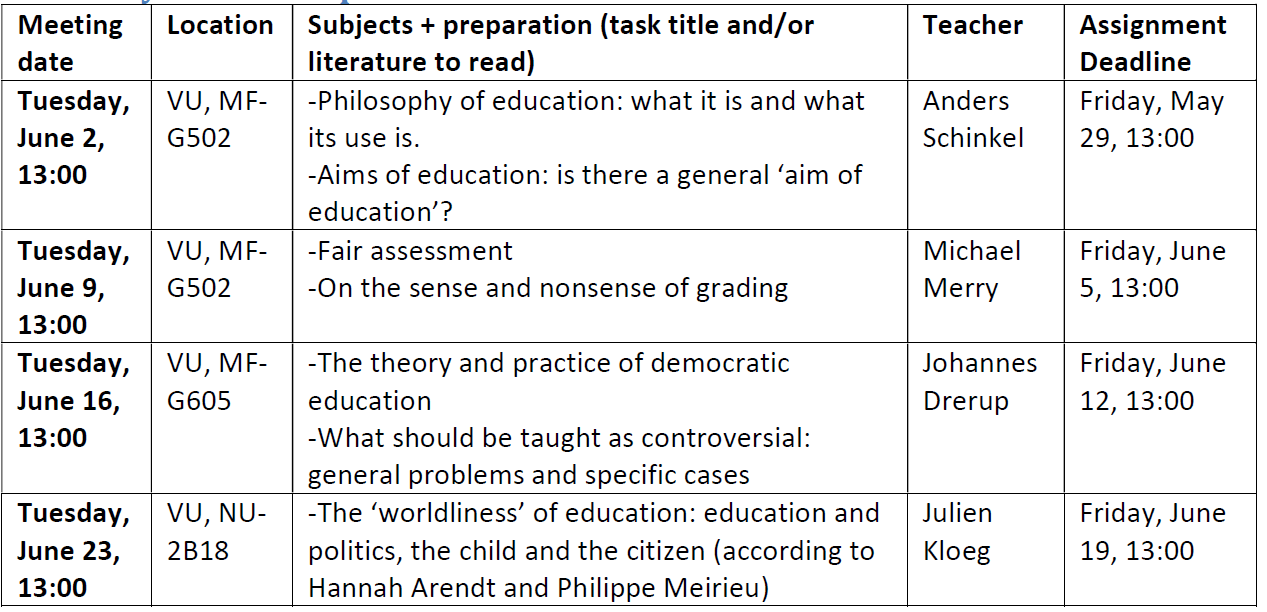
This course will introduce PhD students to the field of philosophy of education by way of four central themes: aims of education, educational justice, democratic education, and the ‘worldliness’ of education.
Location: Vrije Universteit Amsterdam
Course objectives
The central objective of this course is to introduce beginning researchers in the Educational Sciences to a discipline and a mode of thinking they are probably unfamiliar with, namely that of philosophy of education. Though the specific topics covered in the course are among the most debated topics in philosophy of education, and though they may have specific relevance to participating PhD students, it is the initiation into a different way of looking at education, asking other types of question, and using other than empirical approaches to answering them, that is most important. Corresponding more specific objectives are the (further) development of a disposition to critically question silent assumptions (one’s own, or that of one’s research field or discipline); of open, receptive attention to situations, problems, texts, and so on; and of habits of sound and careful reasoning.
Entry level
There are no special entry requirements, but it would be most helpful to take this course early in the PhD trajectory.
Format:
All three meetings follow the same format
- Preparation beforehand (reading /assignment): read the two papers and prepare a substantive (0,5-1 page, 2-4 paragraph) response; submit this via the designated folder on surfdrive on the Friday preceding the meeting at the latest. (In the folder ‘Meeting 1’ you’ll find the literature and a subfolder for the assignments, etc.)
Also prepare at least 1-2 questions related to the readings for the discussion during the meeting; include these in the submitted document.
- Describe lecture or workshop (what information will be given, in what way, see the list of work forms below): The meeting has the format of a brief introduction by the lecturer followed by indepth discussion of the papers/issues on the basis of your questions.
- Assignments (how will the information be processed, learning objective); You will receive feedback on your critical response to the readings, to which you respond online; this may go back and forth a couple of times. The resulting three discussions form a small portfolio on the basis of which, together with your participation in and preparation for the meetings, it will be decided whether you have passed or failed the course.
- Assessment and feedback / peer-feedback: Feedback from the lecturer on your response to the readings; assessment on the basis of your responses and participation.
Requirements:
- Failure to submit responses before the deadline (4 days in advance of the meeting) may affect your final grade.
- Presence at and active participation in all meetings: if, due to circumstances beyond your control, you can’t attend a particular meeting, notify the lecturer in advance; an alternative assignment may be assigned.
- Fulfilment of all reading assignments and practical assignments (response papers, questions prepared for discussion).